
Technical Insights
Industrial PCB Assembly:
What to Prepare Before Requesting a Quote
At a glance
Prepare seven items before requesting an industrial PCB assembly quote: application and delivery scope, BOM, PCB and assembly documentation, quantities and schedule, material sourcing responsibilities, testing and acceptance requirements, and delivery destination and documentation requirements. Keep revisions consistent and clearly identify any open items.
When selecting an industrial PCB assembly partner, companies often begin with pricing, minimum order quantities, and lead times. A useful quotation, however, starts with three questions: where will the board be used, what needs to be manufactured, and how will the finished assembly be accepted?
What Information Should a PCBA RFQ Include?
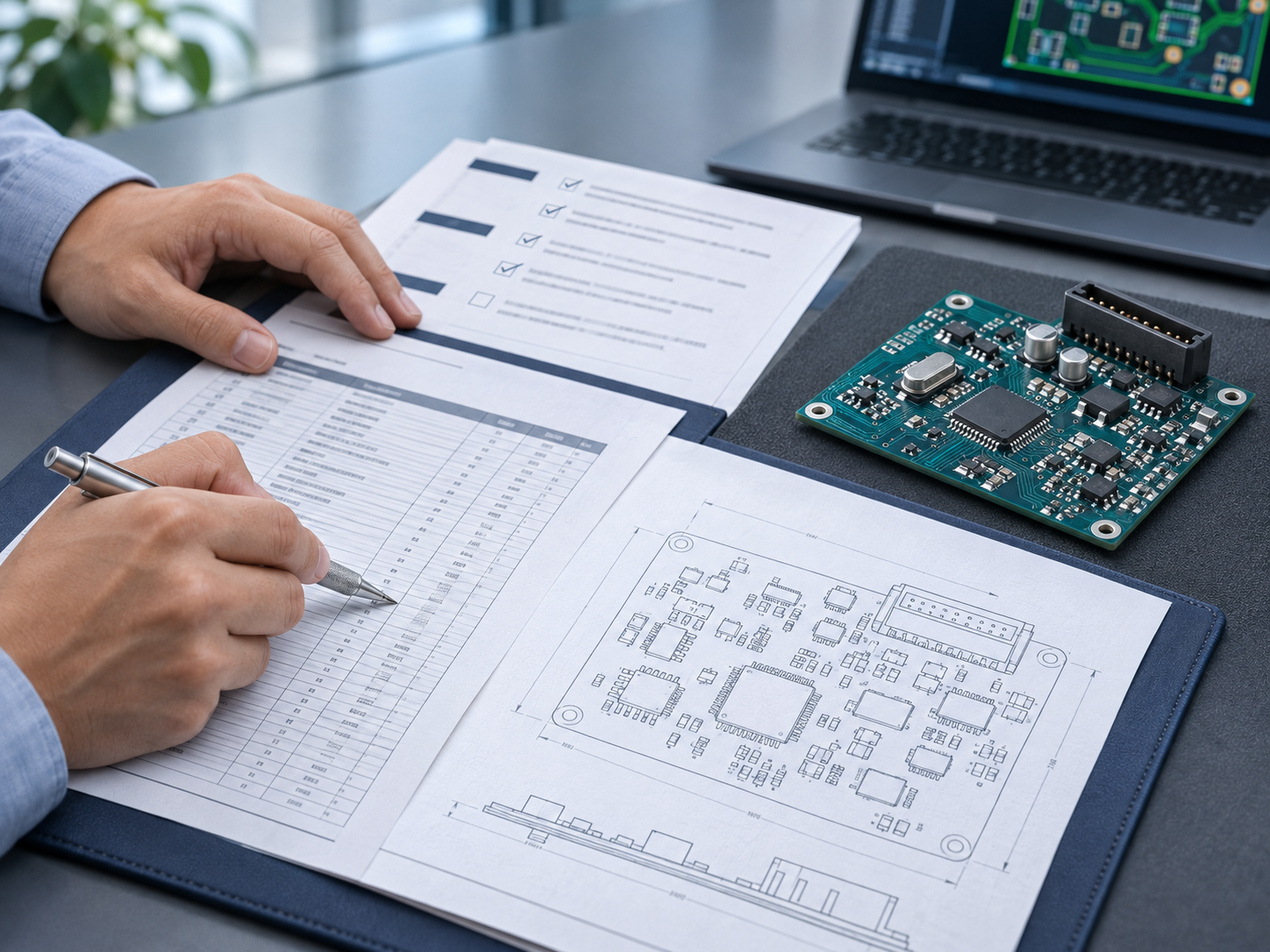
Use this checklist as a starting point for your request for quotation (RFQ), and confirm file requirements with the manufacturer. The BOM identifies the components; placement data specifies their position, rotation, and board side.
| Information | Recommended details |
|---|---|
| Application and delivery scope |
Product purpose, key functions, operating environment, and whether the deliverable is a PCBA, module, or complete assembly. |
| Bill of materials (BOM) |
Component manufacturers, full part numbers, quantities, reference designators, and approved alternatives. |
| PCB and assembly documentation |
PCB fabrication data, such as Gerber and drill files, board specifications, placement data, and assembly drawings, as applicable to the outsourced scope. |
| Quantities and schedule |
Prototype quantities, expected production batch sizes, estimated annual demand, and target delivery dates. |
| Material sourcing responsibilities |
Customer-supplied versus manufacturer-sourced components, including any specified brands or sourcing restrictions. |
| Testing and acceptance |
Firmware programming, functional testing, fixtures, record retention, and shipment acceptance criteria. |
| Delivery destination and documentation |
Target delivery country/location and any required test reports, traceability records, or other delivery documentation. Confirm the scope with the manufacturer. |
Keep design files at a consistent revision. Mismatched BOMs, Gerber files, and assembly drawings can delay engineering review or cause assembly errors. Identify revisions, dates, and open items, then confirm the approved revision before production.
How Do RFQ Priorities Differ by Industrial Application?
Industrial electronics include motor and inverter controls, programmable logic controllers (PLCs), automation equipment, and HVAC and building automation controls. EEC’s published applications include motor controls, PLCs, heating and air-conditioning controls, and remote control systems for buildings.
Motor Control and Drive Applications
Describe operating voltage, current, load conditions, and thermal constraints. Clarify whether the outsourced scope is limited to PCB assembly or includes other modules and mechanical components.
PLC and Automation Control Boards
Identify input/output interfaces, communication requirements, firmware revision, and the control functions to be verified. These details support discussions about assembly and testing.
HVAC and Building Automation Control Applications
Explain sensor interfaces, control outputs, installation environment, and operating modes so that manufacturing and test requirements reflect the intended application.
These are suggested discussion points, not a requirement to use the same materials, processes, or tests for every industrial control board.
Why Discuss Production Requirements During Prototyping?
A prototype build is more than a small production order. It is also an opportunity to evaluate the design, assembly approach, and test process. New product introduction (NPI) can combine manufacturability reviews, material checks, pilot builds, and test planning to establish documentation and processes for subsequent production.
Prototyping: Identify functions to validate, design elements that may change, and sample acceptance criteria.
Production: Confirm the released design revision, approved materials, test procedures, and delivery arrangements so the full scope does not need to be reopened after prototype approval.
Annual demand estimates can support planning, but distinguish forecasts from firm purchase commitments.
How Should You Compare PCBA Quotations?
Quotations may cover different sourcing and manufacturing responsibilities, and order quantity can affect unit cost. Compare the same quantities, document revisions, and scope. Separate PCB and component costs, assembly charges, and one-time engineering or fixture costs. Confirm whether programming, testing, packaging, and shipping are included.
Automated optical inspection (AOI) and functional testing are not interchangeable. AOI checks for visible assembly defects; functional testing evaluates operation against defined requirements. A quotation that includes “testing” should not be assumed to cover every product function.
Frequently Asked Questions
Q1: Are Gerber Files Enough for a Complete PCBA Quote?
Usually not. Gerber files primarily provide PCB fabrication information. A complete assembly assessment also needs to identify the components and their placement. Prepare the BOM, assembly data, quantities, and testing requirements, then confirm the manufacturer’s specific file requirements.
Q2: Can I Request a Quote Before the Design Is Finalized?
Provide the current design revision and flag any open component, quantity, or testing decisions for initial discussion. Distinguish a preliminary estimate from a formal quotation, and confirm final documentation, pricing, and delivery dates before production.
Q3: Can Alternative Components Be Used When Parts Are Unavailable?
Do not substitute components solely because their specifications appear similar. Review electrical characteristics, packaging, pin compatibility, and operating requirements; validate where necessary; then update the BOM and documentation after approval. Substitution is a controlled engineering change, not simply a purchasing decision.
Q4: Can a Project Start with Prototypes Before Moving to Production?
Include a phased plan in the RFQ so prototype quantities, validation activities, and subsequent production can be discussed separately. Acceptable batch sizes, material conditions, and lead times depend on the project, rather than a universal minimum order quantity or delivery promise.
Discuss Your Industrial Electronics Project with EEC
EEC provides SMT, through-hole/DIP assembly, PCB assembly, and engineering support, including Design for Manufacturing (DFM), new product introduction, and test engineering. Share the application, estimated quantities, and target schedule to discuss the next assessment, then agree on how design files and test information should be provided.
A well-prepared RFQ does more than establish a price. It helps engineering, procurement, and manufacturing teams agree on the project scope.